
Imagine for a moment that a man is in a car wreck. He is later taken to the hospital where he dies. By the time his family comes to see him, his body is starting to stiffen and his eyes are wide opened.
Someone says, “his body was mangled in a terrible car wreck.” Another person says, “his body was stiff and cool to the touch when I saw him.”
Are these contradictions? Or are these just two different time frames of when a person experienced this man’s death?
Obviously both are correct. It is just at different times. The same applies to the death of Judas. Let’s read the texts:
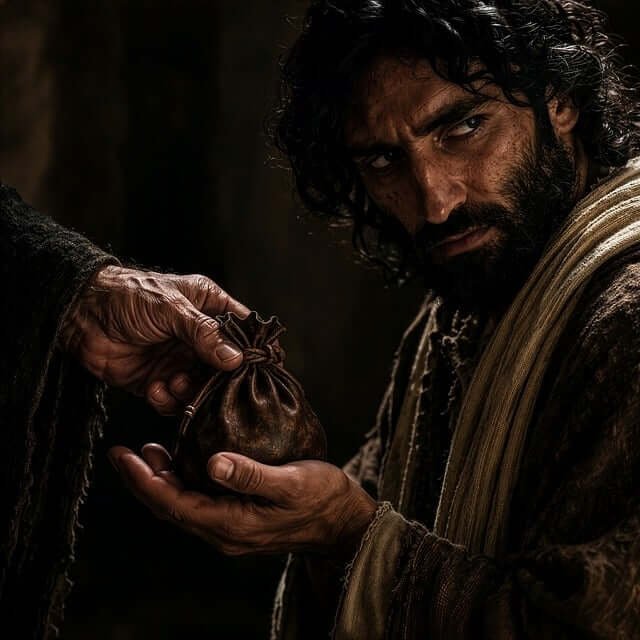
“Then when Judas, his betrayer, saw that Jesus was condemned, he changed his mind and brought back the thirty pieces of silver to the chief priests and the elders, saying, “I have sinned by betraying innocent blood.” They said, “What is that to us? See to it yourself.” And throwing down the pieces of silver into the temple, he departed, and he went and hanged himself” (Matt 27:3-5).
“(Now this man acquired a field with the reward of his wickedness, and falling headlong he burst open in the middle and all his bowels gushed out.)” (Acts 1:18).
Some Islamic teachers will say that this is clear proof of a contradiction. Did he hang himself? Or did he fall headlong and burst open?
It is not a contradiction in the slightest. We know from Matthew that Judas hanged himself. The key is when he fell and burst open and his bowels gushed out.
He didn’t happen to just fall and his guts explode. This is something that only happens when a body has been decaying and decomposing. Otherwise the bowels, even in the most violent of wrecks, rarely bursts and comes gushing out.
To recreate the scenario,
1) Judas is so overcome with grief he hangs himself. No one finds him for awhile as he hung himself out in a field. His body began to decay in the heat of the sun.
2) Eventually his body fell due to the breaking of the rope, decomposition, or something else. When his body fell, it was so decomposed by this point that it burst open and his bowels gushed out.
The second issue stems around who bought the field.
“But the chief priests, taking the pieces of silver, said, “It is not lawful to put them into the treasury, since it is blood money.” So they took counsel and bought with them the potter’s field as a burial place for strangers” (Matt 27:6-7).
And here it seems to indicate Judas bought the field:
“(Now this man acquired a field with the reward of his wickedness, and falling headlong he burst open in the middle and all his bowels gushed out.)” (Acts 1:18).
It is a real question. If the high priests bought the field, but they used Judas’ money to buy the field, did it belong to Judas? or does it belong to the chief priests? The question is whose money did it belong to? In a sense, both are correct. It was Judas’ money, and the priests used it to buy a field, but they didn’t want association with it because it was “blood money.”
In this sense,
- The priests were the direct purchasers
- Judas was the source/funding behind the purchase
This is similar to how Scripture sometimes attributes an action to the person ultimately responsible rather than the intermediary.
For example, in 1 Kings 6-8, it was Solomon who actually constructed the temple. But in Scripture it speaks of David building the temple (1 Chr 22:14).
But elsewhere Scripture speaks as though David did it because:
- David planned it
- financed it
- prepared materials
- commissioned the work
So was it Solomon? Or David? In a sense, both. But in how it is used contextually depends on what name shows up.
Is the story of Judas, then, contradictory? Not at all.
- Judas betrayed Jesus and earned money from it.
- He felt guilty and threw it back at the chief priests
- The priests bought land to be a cemetery with it but disassociated with the money since it was blood money
- Judas hangs himself
- After some time his body drops and his bloated body explodes